Also called the yellow-legged hornet. It is trying to get a foothold in the UK. Know it, report it, and leave the nest to the professionals.
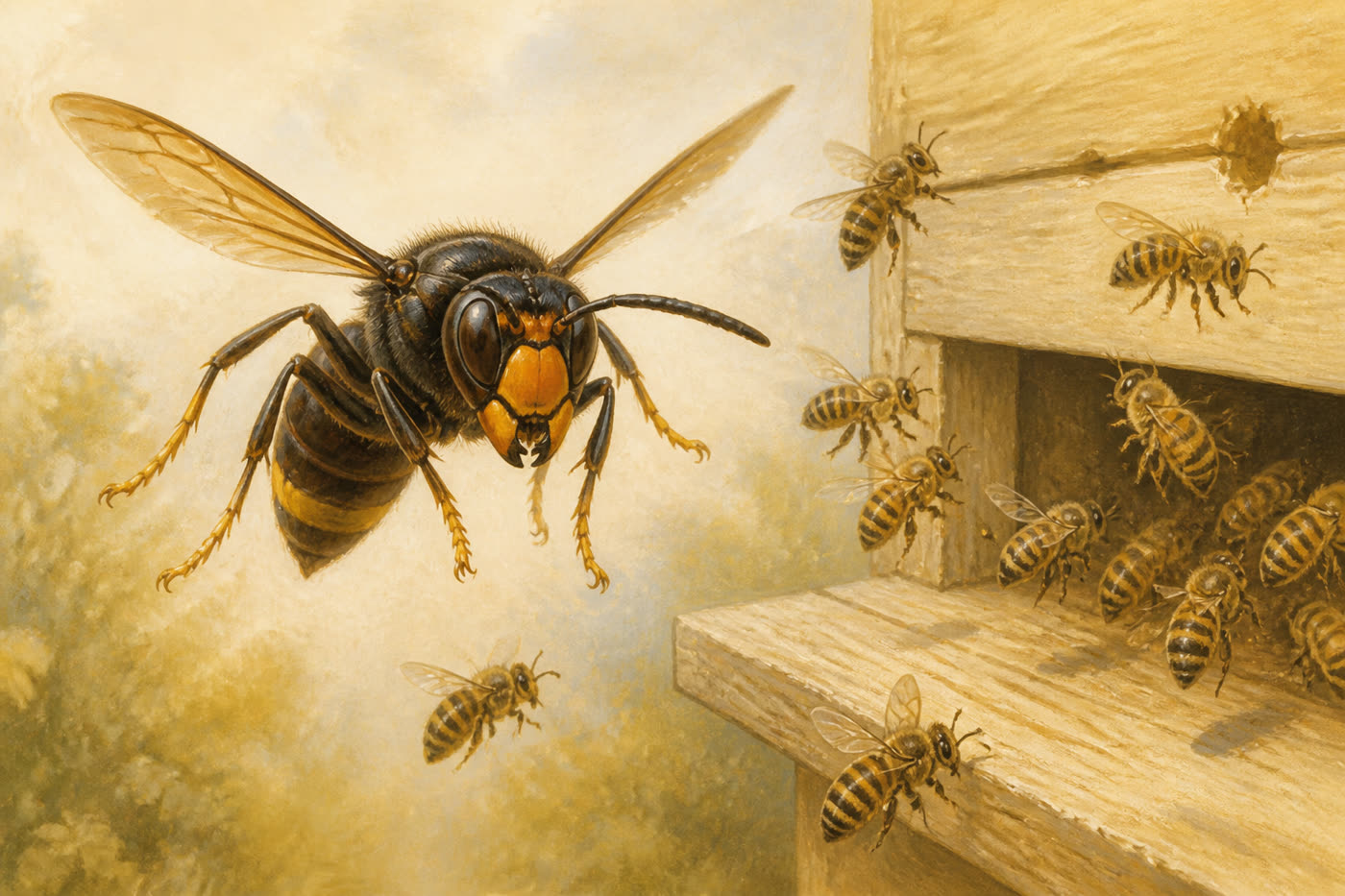
Illustration: hawking at a hive. Use the ID list below, not this picture alone, before you report.
Where it comes from
The insect is Vespa velutina, native to Asia (including China and much of south-east Asia). The dark form seen in Europe is often called nigrithorax.
It reached south-west France in 2004, most likely in a shipment from China, and then spread through France, Spain, Portugal, Italy, Belgium, the Netherlands, Germany, Switzerland and the Channel Islands. The first UK nest was found in Gloucestershire in 2016. Nests have been found and destroyed in several years since. The aim is still to stop it establishing here.
How to identify it
It is smaller than our native European hornet, and much darker than a common wasp. Look at the whole insect, not just the size.
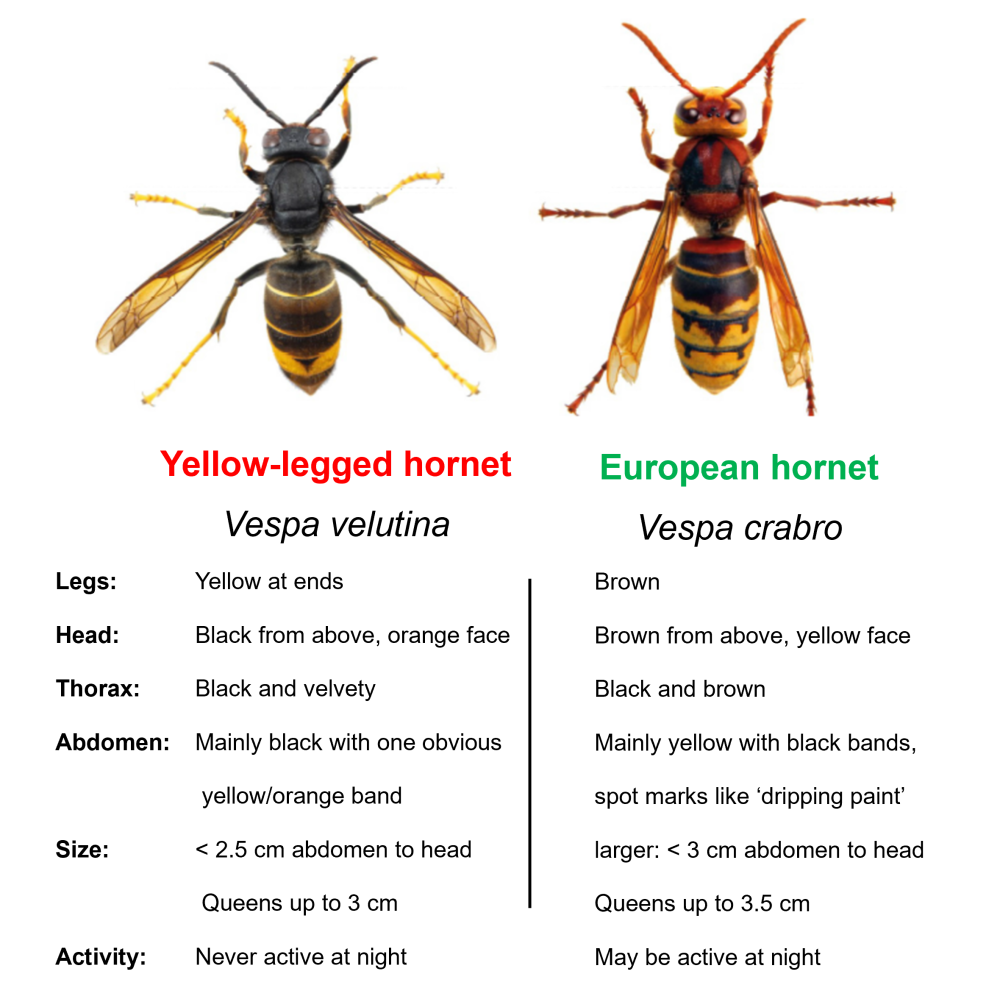
Yellow-legged hornet (Asian hornet) on the left, native European hornet on the right. Use the table. Do not kill the insect on the right.
Legs: dark near the body, bright yellow at the tips. This is the giveaway.
Body: dark brown or black, velvety, not stripy yellow like a wasp.
Abdomen: almost all dark, with one yellow-orange band on the fourth segment.
Face: orange from the front; the top of the head looks dark.
Antennae: dark.
Thorax: entirely black and velvety.
Size: workers about 25 mm, queens up to about 30 mm. Smaller than a European hornet.
When: active in daylight, not at night.
Asian hornet
Dark. Yellow socks. Orange face. One pale band on a dark abdomen.
European hornet (native)
Larger. Yellow and brown. Yellow head from above. Brown legs. May fly at night. Do not kill it.
Most reports turn out to be native wasps, hoverflies, or European hornets. Take a photo if you can. Do not spray or knock a nest.
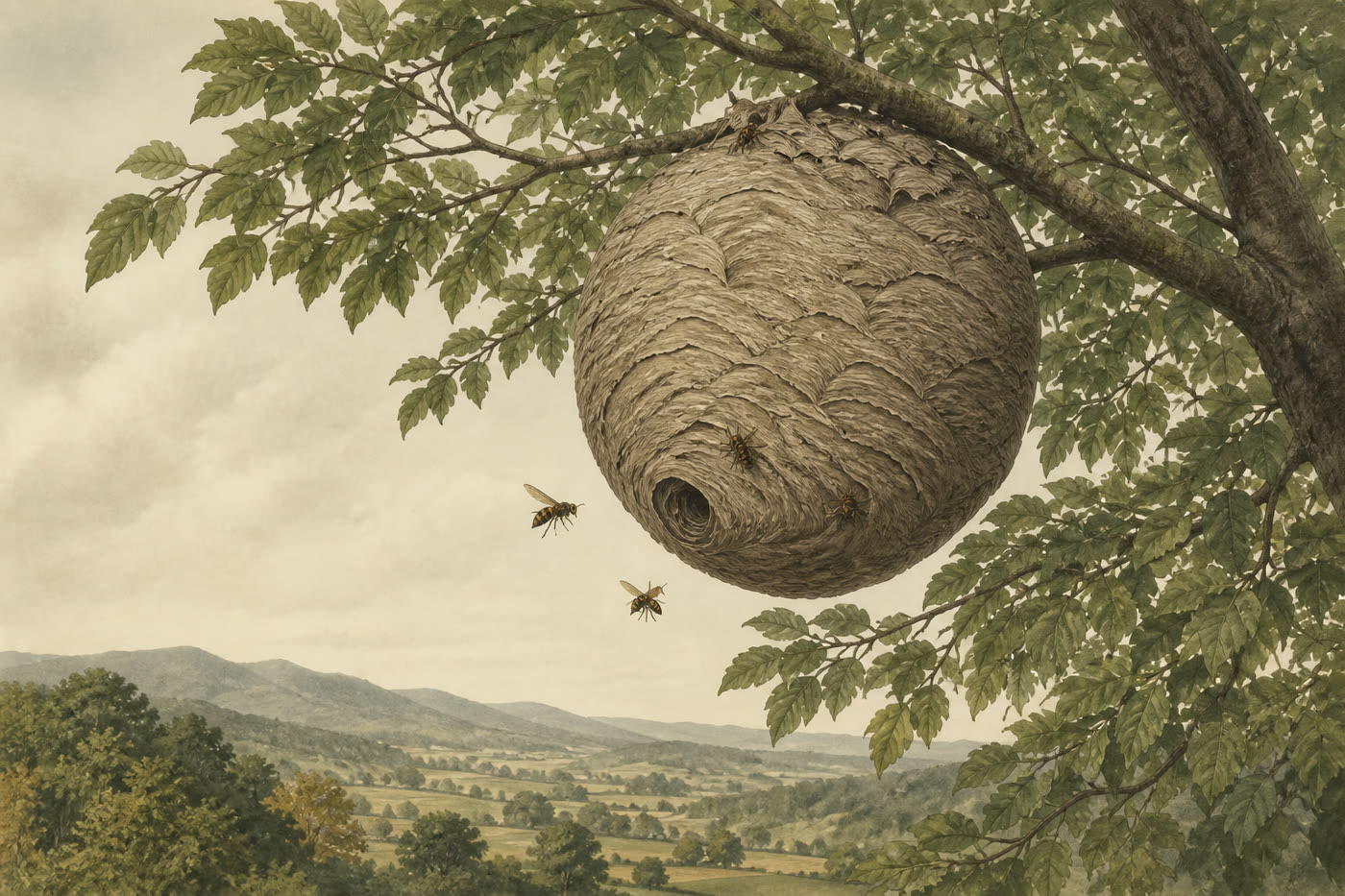
Illustration of a typical secondary nest, high in a tree. Primary nests can be lower, even in sheds or hedges.
What it does
It is a hunter. Workers hover at hive entrances and snatch honey bees as they come and go. A nest can take a heavy toll on a colony, and in places where nests are dense it also hits other pollinators: wild bees, wasps, flies. Honey bees here have not evolved a defence against this particular predator.
Stings are painful. For anyone allergic to wasp or hornet venom they can be dangerous. The insects are not looking for a fight, but they will defend a nest in a group if it is disturbed.
No predator here to keep it in check
In its native Asia, other animals (including some birds that raid wasp and hornet nests) help keep numbers down. The UK has no predator that controls this species. Honey buzzards can take wasp nests, but they are scarce and will not stop an invasion. Without that check, a single nest can produce many queens in autumn, and each queen can start a new nest the next spring.